
Field notes / founder story
The car is going there anyway. Why can’t you ride along?
The stakes are safety, household budgets and access to opportunity. The ambition is global. The work starts in Lagos.
Your next ride may already be driving past you.
Someone is going in your direction with an empty seat. You need to get to work without spending money you need for everything else.
But you don’t know their route. They don’t know you need a ride. Neither of you knows whether the pickup, the price or the person will be right.
That missing connection is why we’re building TagRides.
Prefer to hear the story? Watch the founder’s 2½-minute pitch, then choose how to help put the first route to work.
“Who am I getting in with?” is a serious question
In Lagos, “one chance” refers to robberies in which criminals pose as transport operators or fellow passengers. It gives the decision to enter an unfamiliar vehicle a weight that a route line on a map cannot capture.
A commuter needs to think about the person driving, the vehicle, the pickup and whether anyone can follow the journey. At the same time, a private ride can cost more than the household budget can repeatedly absorb.
Safety and affordability have to be designed together. People need ways to make everyday journeys with information, visibility and a fare that makes sense.
The cost of a commute follows you home
Transport is the expense that makes other opportunities reachable.
A job offer still requires a way to get to work. A place in school still requires a way to reach class. A customer across town still requires a journey whose cost makes sense.
When that journey takes too much money, the trade-off appears elsewhere in the household budget. When it becomes unpredictable, people have to build their day around the uncertainty.
Our early research gave us a clear starting point. In our published survey of 210 Lagos riders, 192 named pricing as a priority. Convenience and safety were also prominent: 153 and 147 respondents respectively named them as priorities. These findings describe our survey sample.
Those responses shaped the product brief: build for people who need a useful journey at a price they can repeat.
Lagos already knows how to share a journey
Danfo and keke operators, commuters who recognise one another, neighbours heading towards the same junction: shared travel is part of how Lagos works.
There is practical intelligence in those routines. People know the routes, the interchange points and the difference a fare makes.
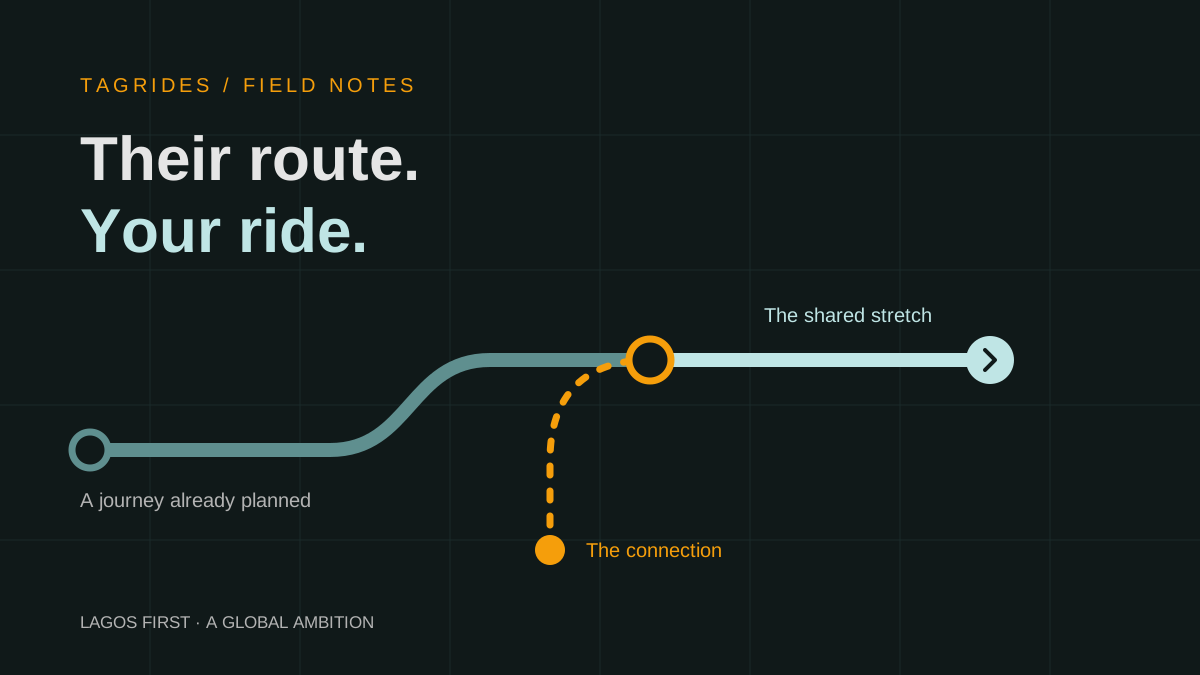
TagRides builds on that existing behaviour. Our Along model helps riders discover drivers travelling compatible routes, review driver and vehicle information, agree a fare and share the stretch that works for both.
The driver has a destination. The rider has an overlapping journey. The product helps them find the fit.
Their route. Your ride.
The economics start before the app opens
A driver who already plans to make a trip has a different starting point from a driver making a separate journey specifically for one customer.
That creates an opportunity to share costs and make available passenger capacity useful.
It does not make carrying a passenger costless. Pickup time, operating expenses, platform fees and the driver’s effort still matter. A fare has to work for the person providing the seat as well as the person using it.
Our target is fares that can compete with public transportation on suitable routes, while leaving participating drivers with worthwhile earnings.
Here is the mechanism: the driver already intends to cover much of the route, and the rider contributes for the stretch they share. Multiple passengers can contribute to the same planned journey. That creates a different economic starting point from a dedicated car hired for one customer.
The comparison must include any additional paid connections the rider needs. A cheap shared leg is useful only if the complete trip works. The pilot will test those numbers against what commuters actually use today.
The ambition is affordability that survives ordinary use.
An empty seat needs a reliable connection
Being near a car does not tell you whether it is going your way, whether a seat is available, what the fare would be or who is driving.
The TagRides MVP brings route matching, fare agreement, driver verification workflows, live tracking and trip records into one product.
Those features give riders information before boarding and a record around the trip. They are practical accountability tools; they do not make any journey risk-free or establish that TagRides has already reduced crime.
Together, those capabilities address practical questions:
- Does this journey overlap mine?
- Where can we meet?
- Who am I travelling with?
- What have we agreed to pay?
- What record exists if something needs resolving?
A rider may walk to a pickup or use TagRides for only part of a longer journey. Supply depends on compatible drivers. The service has to fit the trip people actually need to make.
That is the infrastructure we want to build: a dependable way to turn suitable existing journeys into shared transport.
The problem crosses borders
The United Nations’ 2024 SDG report found that only six in ten urban residents had convenient access to public transport, based on 2023 data from 2,039 cities in 188 countries. That is a worldwide access gap. It is not an estimate of how many people TagRides can serve, or a measure of ride-hailing affordability.
Think about a worker whose shift ends after the last bus, a commuter facing an expensive connection to a rail station, or people making similar journeys from an underserved neighbourhood. These are possible use cases wherever compatible passenger capacity and unmet travel needs overlap.
The opportunity may appear in an African city, an Asian urban corridor, a Latin American neighbourhood, or a poorly connected suburb in a wealthier country. What matters is whether enough people and suitable drivers share routes and travel times, and whether local costs, rules and pickup arrangements allow a useful service.
Public transport investment remains essential. A shared-route service could complement that network by helping people reach an interchange or cover a difficult connection. Each new place would need its own evidence and local operating work.
A global ambition has to work on an ordinary Lagos morning
The MVP is built and in internal testing. We are preparing a focused Lagos pilot around Yaba, bringing together a small driver group and a commuter community with overlapping routes and travel times.
The next questions are concrete.
Do people complete paid rides? Do they come back on their next normal commute day? Do drivers find the earnings worthwhile? Are pickups practical? Can support issues be resolved well?
Those answers will tell us what to improve and whether the model deserves to expand.
Our grounding is specific: research with Lagos riders, a product built around overlapping journeys and current outreach to potential operators and commuter hosts around Yaba. The route, dates and partner arrangements still need to be agreed. That is the work of turning a working product into a useful local service.
Our ambition is to help make everyday mobility more accessible at a scale that could eventually reach billions. That is the horizon we are working towards. The next proof is much closer: people on one route choosing to use the service again.
We have had help getting this far
The journey has included a Tony Elumelu Foundation grant, support through the Ugwumba Enterprise Challenge, and the founder’s ALX Ventures programme experience. Cloud credits from AWS, Microsoft and Google have also supported the build.
Microsoft for Startups Founders Hub membership and participation in the Google for Startups ecosystem are part of that journey. These contributions have taken different forms: grant and enterprise support, programme experience and technology resources.
They helped us reach a built MVP. The next milestone needs people and operating resources on the ground: suitable drivers, a commuter community and the coordination to run and learn from the pilot.
Help put the first route to work
We are looking for sponsors who can support a defined part of that work, alongside passenger-vehicle owners and commuter-community organisers around Yaba who could help assess the pilot.
An introduction, an agreed service provided in kind, or funding for a specific pilot expense could each help us move forward.
Choose how to support the Lagos pilot—through a business contribution, a sponsorship conversation or a useful introduction.
The seat may already be there.
Let’s make it useful.
TagRides. Their route. Your ride.