
Shared Value / 02 / Shared Value
Getting around should leave room for a life
School, business, appointments or time with family—a useful journey should fit your budget and your plans.
News context checked 25 September 2026 · Reporting dates appear with the sources.
A class to get to. A customer to meet. An appointment you cannot miss. Before you set out, there is already a decision to make: how much can you afford to spend getting there?
In Lagos, that decision can follow you through the day. A fare paid in the morning changes what is left for lunch, supplies for a small business or another essential trip. The journey home changes the weekly budget. An extra connection can turn a manageable outing into one you have to reconsider.
And money is only part of it. You want to know where to wait, who you are travelling with, and whether the journey will fit the rest of your plans.
Getting around should leave room for a life. Whether the destination is a school, a workplace, a business meeting, a health centre or someone you care about, the journey should help you take part. That is the rider case for TagRides.
When a fuel headline becomes your fare
The pressure is already visible in recent reporting. On 13 September 2026, LEADERSHIP reported rising road fares in parts of Lagos and Ogun following the latest petrol-price adjustment. Its examples included Atan–Ojuore increasing from ₦1,000 to ₦1,200 and a ₦400 fare on the Ikeja–NAHCO airport shuttle.[6]
The Atan–Ojuore change means an extra ₦200 for that reported journey. For a student, a trader or someone travelling for care, the same destination can suddenly require a different budget. These are route-specific observations, not a claim that all fares rose by the same amount.
That is why affordable mobility is more than a convenience. When the journey is the only way to reach a lesson, a customer or a needed service, postponing it has a cost too.
We started by listening
In our early survey of 210 Lagos riders, 192 named pricing as a priority. Convenience mattered to 153. Safety mattered to 147.[1]
These were people in our company research sample, not a survey of every Lagos resident. Their answers still gave us a clear starting point: an affordable fare is useful only when the journey works around it.
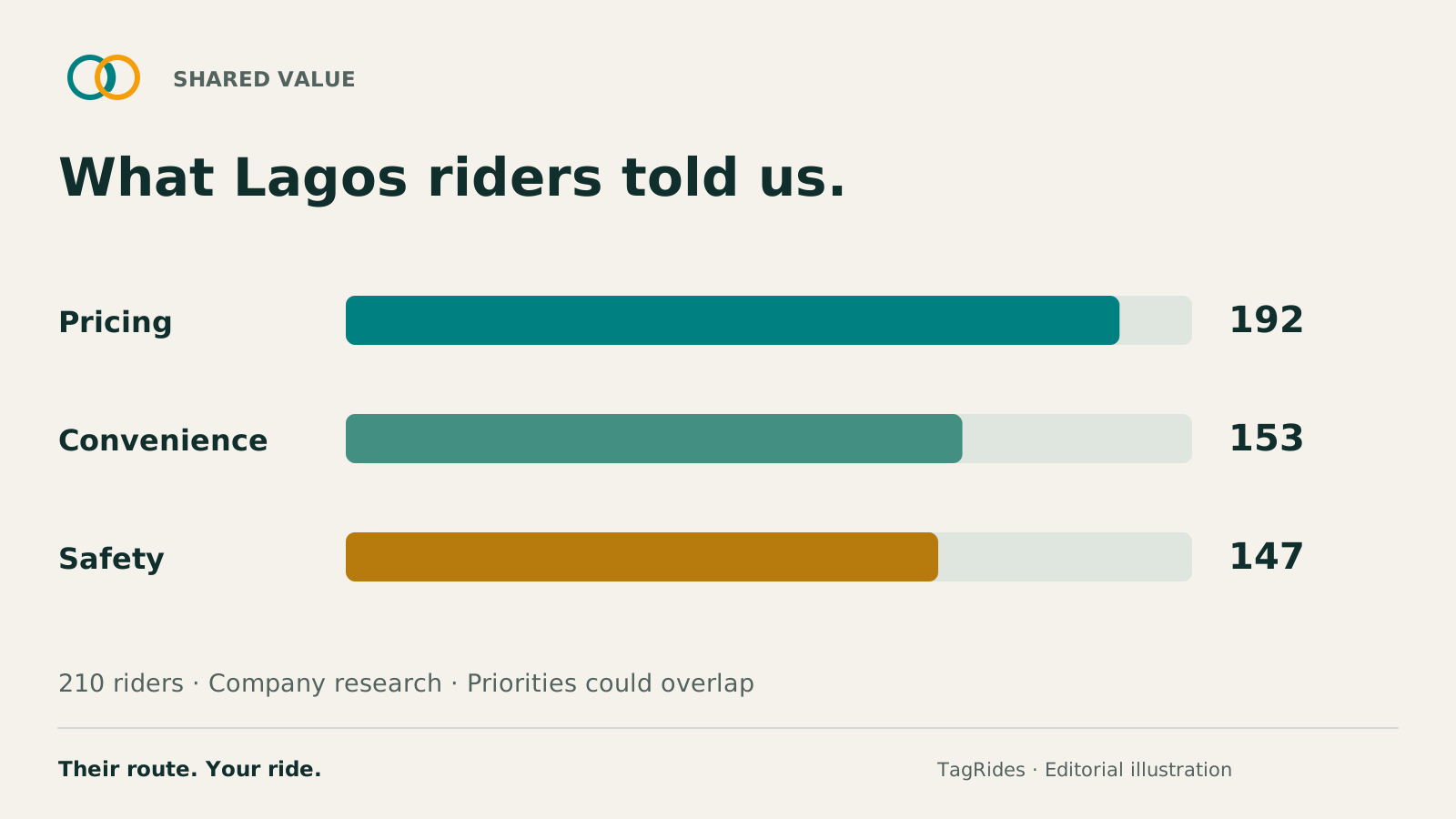
- 192 / 210
- Named pricing as a priority
- 153 / 210
- Named convenience
- 147 / 210
- Named safety
Our November 2024 route research offered another view. For Mushin to Iju Road, the published comparison recorded public or informal transport fares of ₦500–₦900 alongside a ₦5,000 Bolt economy fare. For Sangotedo to Lekki, it recorded ₦1,200–₦1,800 alongside ₦6,400.[2]
These are historical company observations, not current quotes. The services also offer different experiences. But the everyday question remains: if a dedicated car is too expensive to use repeatedly, could a suitable shared seat provide a useful middle ground?
Find someone already heading your way
A driver somewhere nearby may already be making a journey that overlaps yours. The missing piece is knowing where they are going and whether there is room for you.
TagRides' Along mode helps make that connection. You enter your destination, review compatible drivers and agree a fare for the part of the journey you share.
Product view
Start with where you need to go.
Product in development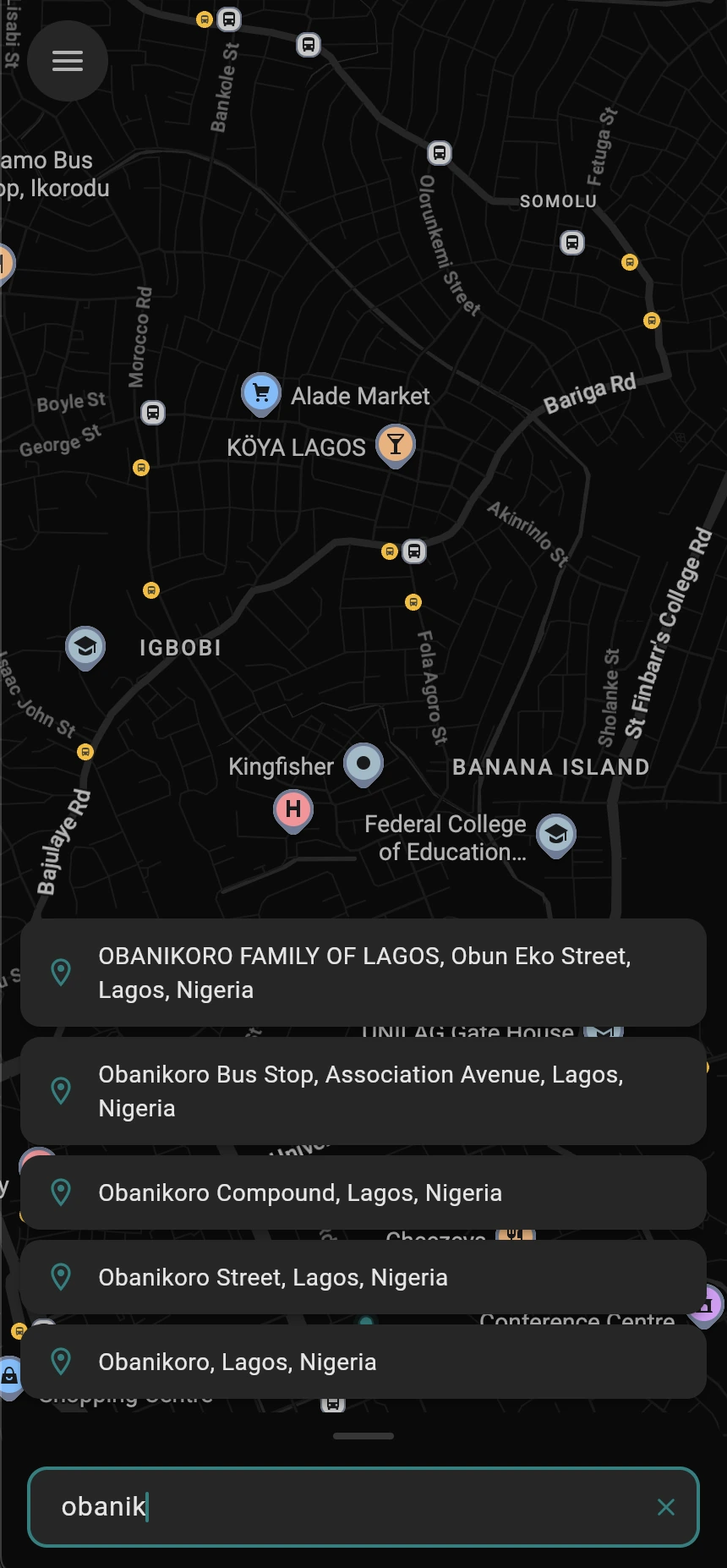
The fare conversation begins with a draft offer. You can review and edit it before sending it. The driver accepts or makes a counteroffer; you decide whether that works for you.[3]
The pickup follows the driver's route. That may mean walking to a stationary vehicle or meeting a moving driver at a suitable point along the way. It is worth considering that walk alongside the fare, especially if you are carrying something heavy or need a more accessible pickup.
The goal is straightforward: make a familiar shared journey easier to find and agree.
A price that fits the whole journey
The cheapest number on a screen is not always the cheapest way home.
A shared ride might cover most of your trip but leave you with a final paid connection. Another option might cost a little more for the shared leg and take you closer to where you need to be. Waiting and walking matter too.
That is why we think about the full journey: the shared fare, any connecting fares, and any relevant fees.
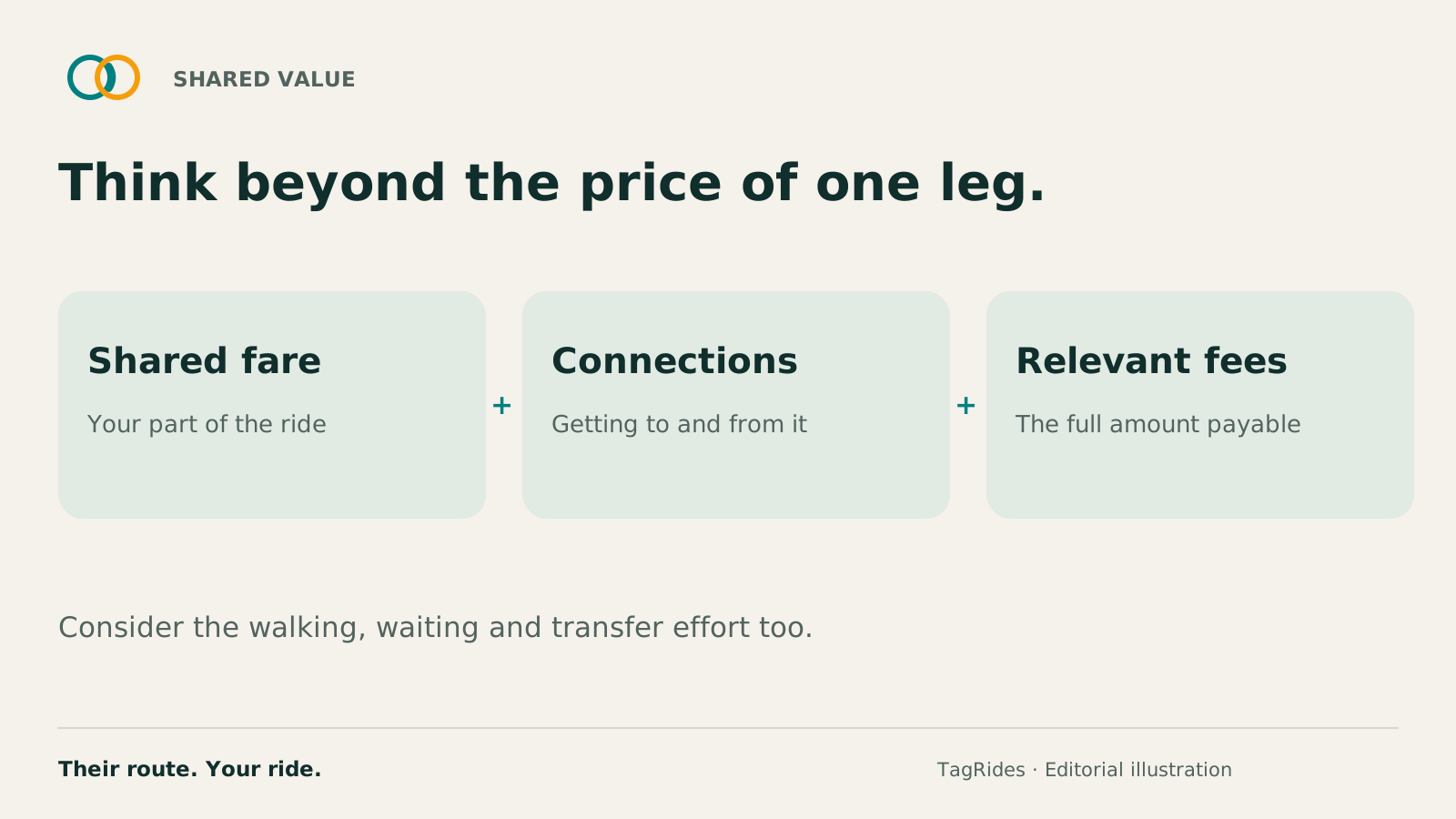
- Shared fare
- Your part of the ride
- Connections
- Getting to and from the shared leg
- Relevant fees
- Include the full amount payable
Agreeing a fare gives you a choice. It does not create money that is not in your budget. Our aim is to make suitable routes competitive with public-transport alternatives while keeping the trip worthwhile for drivers. The pilot needs to test that against what people actually pay and use.
This is also a national priority. On 19 September 2026, Channels Television reported a push for states to expand the National Affordable CNG Transit Programme, with the goal of reducing transport costs for more people from 1 October.[7] CNG is compressed natural gas. Different energy sources and public investment may help, but the important result for a passenger is an affordable service on the route they actually need.
For background on why changes in global oil prices do not immediately reach the pump, Channels' July interview with economist Dumebi Oluwole is useful.[8] It helps explain why riders and drivers cannot build their daily plans around an assumed quick fall in fuel costs.
For riders, success should feel practical: a trip that fits the purpose and the budget. If you need to make it again—to class, to a customer, to an appointment or home—it should still make sense without a one-off discount.
Keep your options in view
Waiting is harder when you do not know what to do next.
Along is designed to let you send separate offers to compatible drivers and keep accepted alternatives available before boarding. The first agreed match becomes the pickup option, and you can switch to another accepted driver while that option remains available.[3]
From the product demo
Keep your driver options in view.
Product in development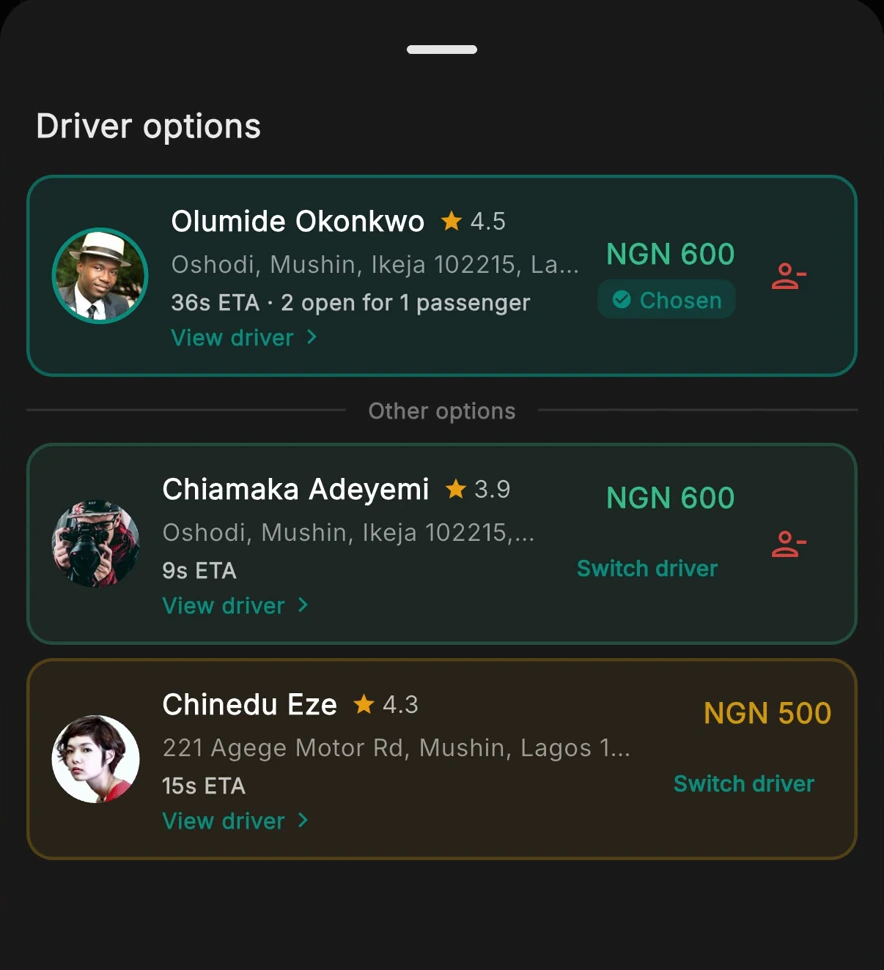
This gives you something practical to work with if your first pickup stops making sense. It is still a live transport service: drivers need to be nearby, travelling the right way and have space. An agreed fare does not guarantee a reserved seat; boarding confirms it.
The benefit is a clearer set of choices before you get in. The test is whether those choices help people complete their journeys, including on the days when the first plan changes.
Know more about the journey you are joining
“Who am I getting in with?” is a serious question.
In Lagos, concerns about “one chance”—robberies involving people posing as transport operators or passengers—are part of how some people assess a ride. Affordability should not require dismissing that concern.
Driver-verification workflows, vehicle information, fare records and trip visibility are part of the product TagRides is building and testing.[3] They help put information around an otherwise brief roadside decision: the person, the vehicle, the agreement and the trip.
A record also gives follow-up a starting point. A disputed fare or a bag left behind should not depend entirely on memory. At the same time, records alone cannot guarantee personal safety or the recovery of belongings.
The pickup itself deserves care. A convenient location on a map is not useful if reaching it means an unsafe crossing. WHO's road-safety guidance includes pedestrian facilities, safe vehicles and safe speeds for that reason.[4]
Good service means making those practical details part of the journey.
The journeys that make a life
Some trips are part of a routine. Others happen because someone needs you, a new opportunity opens up or a service is only available across town.
There is a student travelling to school. A trader going to a place of business. A professional meeting a client. Someone reaching a clinic, a bank or a public service. There are also classes, family gatherings, shops and people you have been meaning to visit. When getting there takes too much of your budget or energy, those plans become easier to postpone.
More useful travel choices could make more of the city reachable. That includes connections to public transport. A shared leg might help you reach a bus or rail interchange, or cover a gap at one end of a journey.
The point is to fit into the transport people already use. A good connection can support a bus journey; replacing a well-used bus with extra car trips would be a different outcome. We will need to understand which journeys TagRides enables and which it replaces.
This is part of the wider ambition behind SDG 11.2: safe, affordable, accessible and sustainable transport.[5] For a rider, it comes down to a more personal question: can I take part in the city without the journey taking too much from me?
Build around the journey people repeat
TagRides' MVP is in internal testing, with a focused Lagos pilot in preparation. We want to learn from whole-journey costs, successful pickups, waiting times, support needs and repeat use.
That repeat journey matters to the business too. A service becomes valuable when riders choose it at ordinary fares and drivers find it worth providing. The strongest case for growth is a useful day becoming a reliable habit.
Our ambition extends far beyond one city: mobility that could become useful to hundreds of millions, and eventually billions, of people. It begins with listening carefully to the people on the first route.
The wider access gap is well documented. The UN's 2024 SDG report, using 2023 data from 2,039 cities in 188 countries, found that only six in ten urban residents had convenient access to public transport.[9] That measures access, not the share of people unable to afford ride-hailing. It gives us a clear reason to think beyond Lagos while researching each market's routes, prices and practical barriers carefully.
Organise a campus, workplace, business association or local community? Tell us where your members travel and when. Help us shape a pilot around a journey that matters.
Their route. Your ride.
Sources
TagRides, published Lagos rider research. Company sample of 210 riders; respondents could name several priorities.
TagRides, Lagos route cost comparison. Company-reported November 2024 research; historical observations of different transport services, not measured TagRides savings.
TagRides product description and pilot information. Current Along design, cross-checked against focused frontend and backend tests; public pilot outcomes remain to be measured.
WHO, Road traffic injuries. Safe-system and pedestrian-infrastructure guidance.
United Nations, Goal 11, target 11.2. Intended contribution, not certification.
LEADERSHIP, Transport Fares Rise In Lagos, Ogun As Petrol Price Hits N1,380/Litre, 13 September 2026. Local station and fare reporting by Yusuf Babalola and Sivowaku Abiodun. Atan–Ojuore is in Ogun; the ₦200 difference is calculated from the reported ₦1,000 and ₦1,200 fares. Not a Lagos-wide average or a current fare guarantee.
Channels Television, CNG: Tinubu Urges States To Scale Up Cheaper Transport Before October 1, 19 September 2026. Programme announcement and attributed government claims, not a guarantee that every route will receive a cheaper service.
Channels Television, Why Petrol Price Is Not Easing Fast — Analyst, 1 July 2026. Interview with Dumebi Oluwole; background analysis from July, not September pump-price evidence.
United Nations, SDG Report 2024, Goal 11, public-transit access section. Data collected in 2023; an urban convenient-access indicator, not a global ride-hailing affordability estimate.